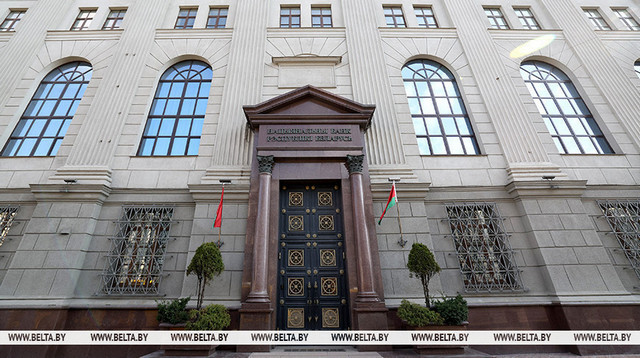
The National Bank of the Republic of Belarus (NBRB) has lowered the refinancing rate to 9.25% per annum. Chairman of the NBRB Board Roman Golovchenko made the statement following a session of the NBRB Board held to review the refinancing rate and the rates on bank liquidity support operations, BelTA has learned.
“Today the Board of the National Bank decided to cut the refinancing rate and the overnight credit rate by 50 basis points. They will stand at 9.25% and 10.75% per annum respectively as from 1 June 2026,” Roman Golovchenko said.
In his words, all factors were analyzed starting with actual and expected inflation, the level of business activity in the country, the situation on the foreign currency market and the credit-and-deposit market and ending with the external background and its possible changes in the future. The emerging trend towards slower inflationary processes was named among the factors that influenced the decision. In 2025 the annual growth of consumer prices settled at 6.8% after hitting a peak of 7.4% in July.
“Inflation continues declining steadily this year. In the first four months consumer prices increased by 2.5% whereas a year earlier they grew by 3.8%. As a result, annual inflation dropped to 5.4% in April, just as we predicted. This is virtually the lowest value for this period over the last two years,” Roman Golovchenko informed.
The main component of inflation, its core element, also decreased. In April 2026 it stood at 5.9% year-on-year after reaching 7.6% in June 2025.
“Trend inflation, meaning inflation stripped of short-term shocks, is currently estimated at around 5% whereas back in H2 2025 it exceeded 6%. According to our estimates, the slowdown in inflation is the result of both external and internal factors. External conditions are turning out to be more favorable. This is why prices for imports are growing less intensively. In particular, annual price growth in the Russian Federation slowed down to 5.6% in April 2026 after hitting 10.2% a year earlier. The indicators characterizing economic processes within the country as a whole also testify to a progressive decline in pressure on consumer prices. It is manifested in more moderate growth rates of the main macroeconomic indicators than last year,” Roman Golovchenko noted.
Another key factor is the stable situation on the deposit market. Personal savings continue steadily flowing into banks, primarily in Belarusian rubles. At the same time, the priority continues shifting towards deposits with longer maturity periods – over one year. The balances on such deposits grew by more than Br2 trillion (by 19%) in January-April 2026.
“Such behavior of the population on the deposit market contributes to a qualitative improvement in the structure of the money supply and also supports the trend towards the economy de-dollarization. For instance, in April 2026 the share of the ruble component in the money supply rose to 66.7% against 65.1% in December 2025. At the same time, fixed-term irrevocable deposits account for more than 32% of the ruble money supply. This is an increase of essentially 30% compared to December 2025,” Roman Golovchenko added.
He also drew attention to the fact that credit growth rates are estimated as moderate. According to NBRB estimates, they do not create conditions for excessive pressure on prices.
“The resources available to banks are sufficient to meet the solvent demand for loans from both organizations and the population. In April 2026 banks’ demands on the economy grew by 11% in annual terms. First of all, the demand is formed for resources in Belarusian rubles. Such demands increased by 16%. At the same time, support for the investment activity of commercial entities remains in focus. In January-April 2026 Br2 billion was loaned for investment purposes. This is 13% more than in the same period of last year,” Roman Golovchenko said.
Apart from that, according to the NBRB forecast, which takes into account the decision made by the NBRB Board, the average monthly rates of core inflation will remain low until the end of this year. Its annual level will stay around 5% according to baseline indicators.
“At the same time, the inflationary impact from the economy will remain near neutral levels and the predicted slowdown of inflation in the Russian Federation, our main trading partner, will become an additional positive factor. Taken together, these factors as well as the predicted balance of risks predetermined the size of the current step in changing the interest rates of the National Bank – 50 basis points,” Roman Golovchenko said.
Speaking about future plans, he emphasized that it is too early to make statements on this matter for now. “We will see how the economy responds to today’s decision, how the situation will develop on the external perimeter, and how stable the macroeconomic processes in our economy will be,” the chairman of the NBRB Board noted, adding that if events develop favorably, it is possible that the NBRB will return to this matter later this year.