


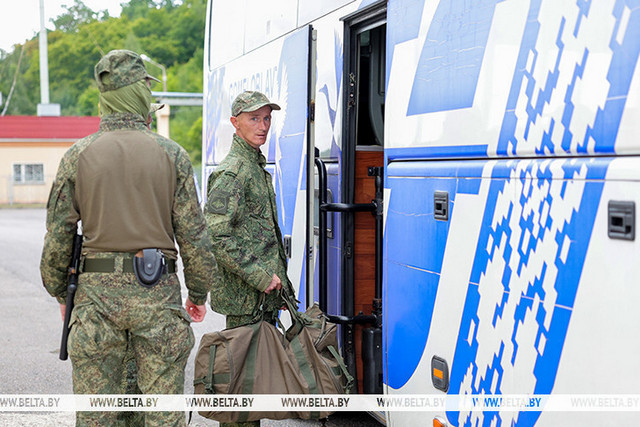
An exchange of prisoners of war between Russia and Ukraine was conducted on the territory of Belarus, BelTA has learned.
Belarus continues to fulfill its humanitarian mission and once again served as a place for the prisoner exchange. Russia and Ukraine swapped over 103 people each.
The Belarusian side arranged the necessary logistical chain creating the conditions for the safe landing of the aircraft at Gomel airport and for the movement of a convoy of buses to the Novaya Guta border checkpoint where the exchange took place.
Each person was provided with hot meals. Adding a touch of tradition, the dry rations included apples and honey, the symbolic offerings of the Orthodox Savior's Feast which is marked on 19 August.For people who had spent a long time away from their families and loved ones and had experienced stressful situations, faith became a true salvation.
Ambulance teams were on hand, ready to provide medical assistance.
Natalya Masterskaya, Deputy Head of the Main Healthcare Directorate of the Gomel Oblast Executive Committee, emphasized that the presence of medical personnel is a necessity during such exchange operations. There were more than 70 of them. Over nearly 2.5 years, medical assistance has been provided to more than 1,500 prisoners of war from both sides. “For us, this is a great responsibility because prisoners of war arrive with various health conditions ranging from satisfactory to extremely severe. We provide each person with the necessary medical care in full right on the spot, and if necessary, we hospitalize them in healthcare institutions of the region. If surgical intervention is required, we perform it or transfer the patient to a higher-level facility, to national healthcare institutions in Minsk,” she said.
Medical assistance is provided equally to prisoners of war from both Russia and Ukraine. Most of the patients have sustained injuries. “Therefore, we perform primary surgical debridement, carry out surgical interventions, and treat complications since these are typically severe patients. We also receive people with strokes; they are hospitalized in intensive care units and undergo rehabilitation treatment. We provide the full spectrum and the entire range of necessary medical care,” Natalya Masterskaya said.
Each ambulance crew is equipped with everything necessary. “We already have experience and are aware of what to expect. So each team carries the necessary stock of medical supplies and medications. Of course, we have a supply of bandages, painkillers, and antiemetics and also blood pressure-lowering medications, antipyretics, and others. We have all the necessary drugs,” Natalya Masterskaya assured.
The main desire of every prisoner of war is to return home as soon as possible and hug their loved ones. One of the Ukrainian servicemen, Igor, tries to keep his spirits up: “My wife, children, mother, and father are waiting for me at home. I’m going back happy. I'm alive."
Two years and eight months of waiting for the exchange were also a serious test for Taras. “I can’t wait to get home. Finally, I'll see my loved ones - my mother, children, wife. We managed to correspond. A letter came from my mother. Everyone is waiting for me,” he said, his voice trembling.
Natalya Masterskaya, Deputy Head of the Main Healthcare Directorate of the Gomel Oblast Executive Committee, emphasized that the presence of medical personnel is a necessity during such exchange operations. There were more than 70 of them. Over nearly 2.5 years, medical assistance has been provided to more than 1,500 prisoners of war from both sides. “For us, this is a great responsibility because prisoners of war arrive with various health conditions ranging from satisfactory to extremely severe. We provide each person with the necessary medical care in full right on the spot, and if necessary, we hospitalize them in healthcare institutions of the region. If surgical intervention is required, we perform it or transfer the patient to a higher-level facility, to national healthcare institutions in Minsk,” she said.
Medical assistance is provided equally to prisoners of war from both Russia and Ukraine. Most of the patients have sustained injuries. “Therefore, we perform primary surgical debridement, carry out surgical interventions, and treat complications since these are typically severe patients. We also receive people with strokes; they are hospitalized in intensive care units and undergo rehabilitation treatment. We provide the full spectrum and the entire range of necessary medical care,” Natalya Masterskaya said.
Each ambulance crew is equipped with everything necessary. “We already have experience and are aware of what to expect. So each team carries the necessary stock of medical supplies and medications. Of course, we have a supply of bandages, painkillers, and antiemetics and also blood pressure-lowering medications, antipyretics, and others. We have all the necessary drugs,” Natalya Masterskaya assured.
The main desire of every prisoner of war is to return home as soon as possible and hug their loved ones. One of the Ukrainian servicemen, Igor, tries to keep his spirits up: “My wife, children, mother, and father are waiting for me at home. I’m going back happy. I'm alive."
Two years and eight months of waiting for the exchange were also a serious test for Taras. “I can’t wait to get home. Finally, I'll see my loved ones - my mother, children, wife. We managed to correspond. A letter came from my mother. Everyone is waiting for me,” he said, his voice trembling.
Anton from the Irkutsk Oblast of Russia also did not hide his emotions. He is returning home after an endlessly long 20 months. In September, his daughter Sofia will start school. Hers was the first voice he heard on the phone. He was breathless with emotion. “I’ve missed everyone so much! I love you all! When I get to Moscow, I’ll call,” he said. The man hopes to walk his daughter to her first day of school together with his wife.
A prisoner of war, Viktor, carefully clutches in his hands a file with photographs of his children and loved ones. The man is heading to Tula, where a large family is waiting to welcome him. He has five children. A daughter, Anzhelina, and four sons, each of whose names begin with the letter M – Mikhail, Maksim, Matvey, and Miron. By the way, he has not yet met his youngest in person, having only seen him in photographs. The baby was born when the father was already far from home. “I read and reread these letters 10-20 times. It gave me strength,” he said.
Russian serviceman Aleksandr also got in touch with his mother. 15 months of worry and endless anxiety in captivity, so the phone call at the Belarusian checkpoint was a true gift. “Mom, I’m already in Belarus. They received us well here. I’ll be home soon!” he greeted her, admitting that he dreamed of hugging his family. In response, an emotional woman’s voice: “We found out yesterday that you were coming. We’ve been running around since yesterday, we can't calm down from happiness,” she said.
Words of gratitude also came from the Commissioner for Human Rights in the Russian Federation, Yana Lantratova. She thanked the Belarusians for the safe corridor, and the Ukrainian colleagues for the constructive dialogue. “It is important that for the first time in a long time, 31 wounded people are being exchanged. They are in various conditions. These are the guys whose mothers, wives, and sisters came to ask personally. Their families and loved ones are very, very much waiting for them. Today, during the journey, I had numerous calls from mothers who asked me about their health. We went through the buses, the ambulances, and talked to them. Many thanks to the Belarusian side, which is helping us conduct this exchange today,” she said.
She said that a routine has been established to keep track of all inquiries from both sides. “We have agreed that we go to see prisoners of war. Since our last meeting, we have visited 618 Ukrainian prisoners of war to check on their conditions of detention. This is truly very important. The same is done by Dmitry Valeryevich [Lubinets, the Commissioner for Human Rights of the Verkhovna Rada of Ukraine] and his team with regard to our guys,” the Ombudswoman stated.
The ombudspersons of Russia and Ukraine also exchanged a large number of letters from relatives and loved ones for prisoners of war on both sides. “This is very important. I know how they are looking forward to receive these letters and how much they mean to them,” Yana Lantratova emphasized. She noted that one of the letters she delivered to a prisoner of war during her last visit contained photographs of his newborn grandson. “The man was overjoyed,” she added.
Work continues on mutual humanitarian exchanges in both directions, the ombudsman assured. “There is also a great deal of work on mutual document exchanges. At the previous meeting, we noted that this process had been launched - a very large number of requests are coming to the offices of ombudsmen in both countries. And today we have already exchanged documents. This means that people will be able to receive the payments, benefits, or other assistance they need to protect their rights. We are continuing this work. Today we discussed the next exchanges. We hope that family reunifications, the transfer of civilians, and prisoner exchanges will take place more frequently between our sides,” Yana Lantratova said.
A number of issues were constructively discussed, the main one being the return of citizens from various categories on both sides, Dmitry Lubinets confirmed. “This includes the return of prisoners of war and the intensification of exchange processes. The second category is civilians who are on the territory of both Ukraine and the Russian Federation. A separate issue is the return of elderly and peaceful citizens. We recently had another humanitarian exchange,” he said.
Constant monitoring of detention conditions for prisoners of war was discussed in detail. “We have agreed that this will be done on an ongoing, systematic basis. We will exchange information after such monitoring. We pay special attention to where prisoners receive meals, how medical care is provided, and how their rights to religious observance are ensured,” the Ukrainian Parliamentary Commissioner for Human Rights outlined.
This work never stops, the two ombudsmen assured, noting that meetings and discussions are not always public. “The most important thing is when we see concrete results,” Dmitry Lubinets emphasized.Irina Kostevich, Chairperson of the Standing Committee on Labor and Social Affairs of the House of Representatives, was also present at the Belarusian-Ukrainian border area. She stressed that another truly important step had been taken. “Belarus is carrying out a very important humanitarian mission. For several years now, a humanitarian platform has been operating here on the instruction of Belarusian President Aleksandr Lukashenko. Today, another humanitarian mission has been carried out. What is its significance, why is it important? The process is ongoing, with regular exchanges in place. Today, the human rights ombudsmen of both Russia and Ukraine are taking part in this platform. A productive dialogue has taken place, and certain cooperation frameworks have been developed - for parcels, for exchanging letters, and for monitoring the whereabouts of prisoners of war. A plan for further exchange actions has also been outlined,” she said. She also noted that words of gratitude were addressed to Belarus. “Today, such a comfortable corridor is being provided, not only in terms of logistics. It is a reliable corridor, an island of safety, as it is now being called,” she added.
Irina Kostevich walked through the buses carrying Russian and Ukrainian prisoners of war. “On behalf of all of Belarus, I received words of gratitude. They thanked us for the cleanliness and warmth of the Belarusian people, for the hot meals, and for the medical care that those in need received promptly. Many said that while traveling through Belarusian land, they felt at home,” she said.
“We will certainly continue this mission. Belarusians are committed to peace and friendship. We very much hope that peace will come soon to both Russia and Ukraine,” the chairperson of the Standing Committee on Labor and Social Affairs said.
Belarus has consistently adhered to a peace-loving position, providing safe humanitarian channels, corridors, and places for organizing exchanges between Russia and Ukraine. More than 70 such events have already been held in Belarus.