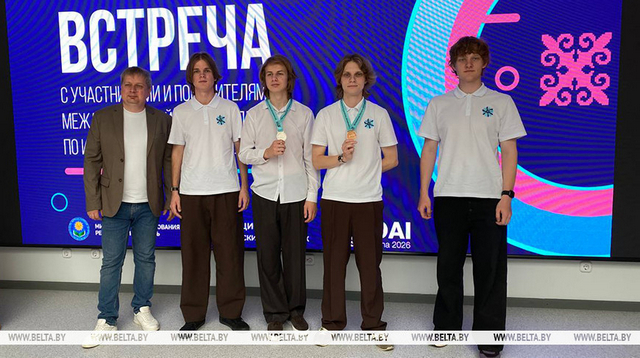
Belarusian school students won silver and bronze medals at the 3rd International Olympiad in Artificial Intelligence (IOAI 2026), held in Astana, Kazakhstan on 2-8 August. BelTA found out how Belarus prepares winners of international Olympiads.
Yevgeny Shkumat, a graduate of the F.E. Dzerzhinsky Lyceum of BSU, won a bronze medal at the AI Olympiad. He has enrolled at BSU’s Faculty of Applied Mathematics and Computer Science. “The Olympiad was certainly challenging. The hardest part for me was probably managing the nerves, because it was not only Belarus’ first time participating in this Olympiad, but also my first time competing in such an international event. The Olympiad consisted of two rounds, with three tasks each day, and we were given 6 hours to solve them,” Yevgeny said.
The most interesting task for him was one where a text was given, and participants had to determine at which point the writing had switched from a human to an AI. “The task was to identify exactly where the AI replaced the human. My idea was to go through every word in the text, take a certain number of words to the left and right, convert them into embeddings, numerical representations of text that preserve meaning, and compare them. If they were similar, the text was still written by a human; if not, it was AI,” the bronze medalist explained.
Timur Sivko, a graduate of Gymnasium No. 1 named after Academician E.F. Karski in Grodno, won a silver medal at the Olympiad. “This was a very interesting experience for me, especially since I had never participated in international Olympiads before. Some parts were difficult, others were straightforward. AI is quite a specific field. We prepared for the Olympiad during training camps: two weeks of classes, two weeks of rest, and another two weeks of classes. And it all worked out,” Timur noted.
He said the secret to his success was the ability to make choices, even when they seem unreasonable. “Don’t be afraid of making seemingly foolish decisions - often they turn out to be the right ones. You can always overthink things, but it’s important to sense what will bring you victory,” the silver medalist shared.
Aleksei Tolstikov, the team leader and Associate Professor at the Department of Computational Mathematics at BSU’s Faculty of Applied Mathematics and Computer Science, believes the victory came from a solid foundation in mathematics, good practical programming skills, and the students’ competitive spirit. “This was our first time participating in such a prestigious event. We did well, but overall I believe we can do even better. Over 100 countries took part in the Olympiad, with 440 school students competing in the main category,” he said.
According to the team leader, participating in international Olympiads helps calibrate the level of both the students and the university environment, while also allowing them to see the global leaders in the field. “After all, artificial intelligence is currently changing the world very rapidly, it is transforming production, education, and society. At this point, no one in the world has yet figured out how to deal with AI - not the technologically advanced countries like China, the USA, or Russia, nor those trying to apply it domestically. We know that some countries provide full access to AI systems within schools. So let’s keep observing, but also take bold steps forward,” Aleksei Tolstikov emphasized.
Participants for the international Olympiad were selected through the national competition Engineers of the Future. The event included individual and team competitions. The tasks were built around three main areas: computer vision, machine learning, and natural language processing. Participation in the AI Olympiad is expected to become an annual event.